

Pre-order on Routledge
Pre-order on Amazon

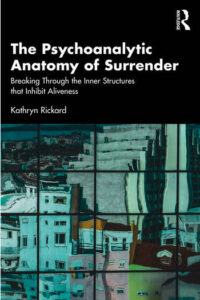
The Psychoanalytic Anatomy of Surrender

Breaking Through the Inner Structures That Inhibit Aliveness

ISBN 9781041340508
220 Pages
October 29, 2026 by Routledge

The Psychoanalytic Anatomy of Surrender offers an original psychoanalytic model of surrender, illuminating how inner structures that inhibit aliveness may gradually loosen through emotional experience, therapeutic work, and psychological transformation.

Through detailed clinical case studies and original theoretical contributions, the book explores surrender as a psychological process unfolding across multiple dimensions of emotional life—from rigidity, defensiveness, and control toward greater receptivity, love, gratitude, wisdom, and deeper engagement with lived experience. Integrating psychoanalysis with philosophy and broader contemplative traditions, Rickard develops a practical framework for understanding psychological transformation in both patients and therapists.

Written for psychoanalysts, psychotherapists, scholars, and psychologically minded readers, this book offers a clinical and conceptual language for understanding surrender and its role in therapeutic growth, emotional development, and psychological aliveness.

“Why I Wrote This Book”

For much of my life, I have been fascinated by a simple observation: people often spend years trying to make reality other than what it is.

We try to make someone love us who does not. We try to make our parents become the people we needed them to be. We pursue acceptance through achievement, appearance, control, or perfection, hoping that if we can just get things right, some deeper longing will finally be satisfied.

In the process, we can lose precious time.

As a psychologist and psychoanalytic psychotherapist, I repeatedly encountered a phenomenon that seemed central to psychological growth yet was rarely described with sufficient clarity. We speak of surrender often, but we do not always mean the same thing. Surrender is frequently confused with passivity, resignation, defeat, or giving up. Yet the form of surrender I observed in clinical work was something quite different.

Over time, I came to understand surrender as a complex, multidimensional process that allows us to relinquish what cannot be controlled and engage more fully with what is. Far from diminishing life, surrender often expands it. It opens the possibility of greater freedom, vitality, creativity, intimacy, and aliveness.

This book is my attempt to bring greater clarity to that process and to explore the many ways that surrender transforms our relationship to ourselves, to others, and to reality itself.


Endorsements

‘In this work Kathryn Rickard explores surrender as a living process, staying close to moments of experience as they unfold. She shows how something in us loosens and begins to come alive in ways that cannot be forced, opening pathways into deeper contact with ourselves and others.’

Michael Eigen, PhD, author of Contact with the Depths, The Sensitive Self, and The Psychoanalytic Mystic; psychoanalyst

‘A new and refreshing bridge between secular psychology and contemplative spirituality, where the practice of psychotherapy reverberates with the timeless spiritual journey. In Kathryn Rickard’s work, I hear echoes of our ancestors: Indigenous healers, biblical prophets, Eastern siddhas, Christian saints, and exemplars like Nicholas Black Elk. Most importantly, she parses this out for us as we seek to recover the fullness of our humanity, giving us permission to surrender not out of defeat, but into the depths of who we really are.’

Damian CostelloPh.D, author of Black Elk: Colonialism and Lakota Catholicism; coordinator of Postgraduate Studies, NAIITS: An Indigenous Learning Community

‘Surrender is often seen as defeat, but Rickard shows that it can unleash our greatest successes. With the serenity to accept what cannot be changed, we gain the will to face our options knowingly, openly, and intentionally. Pairing meticulous theory with in-depth case studies, Rickard offers a clear playbook of directed risk and openness that leads to genuine psychological transformation.’

Richard Granger, PhD, author of Big Brain: The Origins and Future of Human Intelligence; professor, Dartmouth College; director, Brain Engineering Laboratory

‘Kathryn Rickard has written a much-needed volume on the critical psychoanalytic construct of surrender—a term too infrequently discussed and rarely understood. Her timely effort to elucidate surrender is especially laudable. The capacity to surrender, in all its complexities, lies at the core of psychotherapeutic process for both patient and analyst alike. Dr. Rickard clarifies its subtleties through poignant stories and rich clinical examples. This work fills an essential niche in the psychotherapeutic and psychoanalytic literature. Beautifully written in accessible language, it is a gift to both psychoanalytic and lay communities. A must-read.’

Melvin E. Miller, PhD, co-editor of Spirituality, Ethics, and Relationship in Adulthood: Clinical and Theoretical Explorations; Charles Dana Professor of Psychology, Emeritus, Norwich University; Psychoanalyst

‘This book offers a thoughtful and clinically grounded exploration of surrender as it emerges within the therapeutic relationship. While situated within a psychoanalytic tradition, its clarity and depth make it relevant to psychotherapists of all orientations.

Kathryn Rickard develops an original framework for understanding surrender not as a passive state, but as a dynamic process unfolding within both patient and therapist. Drawing on core clinical concepts such as dependence, transference, and the therapist’s capacity for psychological containment, she shows how patients come to tolerate tension, uncertainty, and affect within the analytic encounter.

This is a serious and engaging contribution that will deepen the clinician’s understanding of complex psychological processes and offer meaningful guidance in working with challenging clinical material.’

Louis Brunet, PhD, author of Profession Psychologue; director, Canadian Institute of Psychoanalysis (International Psychoanalytic Association); former professor, Université du Québec à Montréal; psychologist and psychoanalyst

“Author Section”

Kathryn Rickard, Psy.D., is a licensed clinical psychologist and psychoanalytic psychotherapist with more than twenty-five years of clinical experience. She maintains a private practice in Vermont and is authorized to practice telepsychology in forty-two states through PsyPACT.

Throughout her career, Dr. Rickard has been drawn to questions of limitation, acceptance, freedom, and psychological growth. Her clinical work has repeatedly brought her into contact with the ways people struggle against realities that cannot be changed and the profound transformations that can occur when those struggles begin to loosen.

The ideas explored in The Psychoanalytic Anatomy of Surrender emerged from decades of clinical practice and sustained reflection on the relationship between surrender and aliveness.